External Adapter Encryption and Decryption
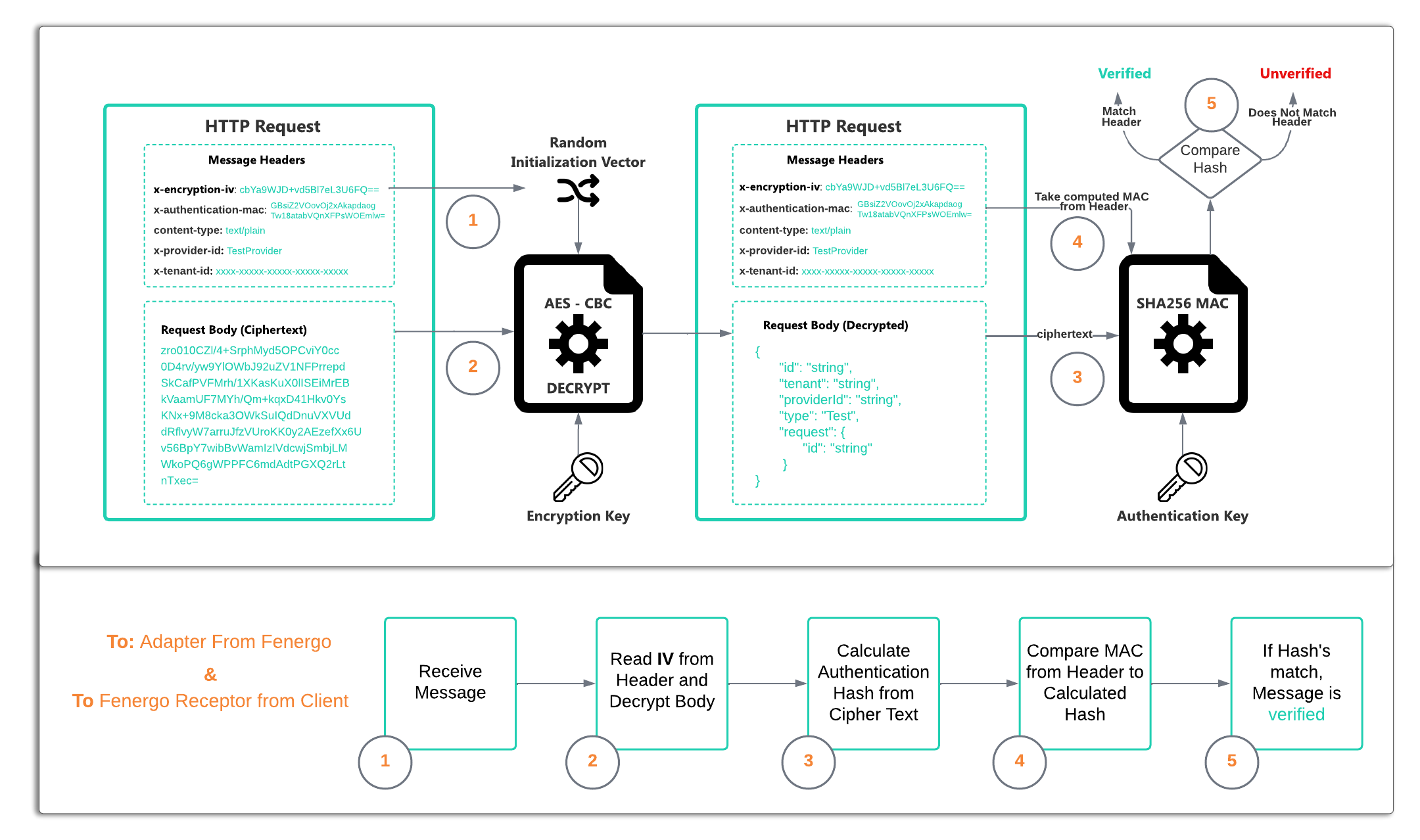
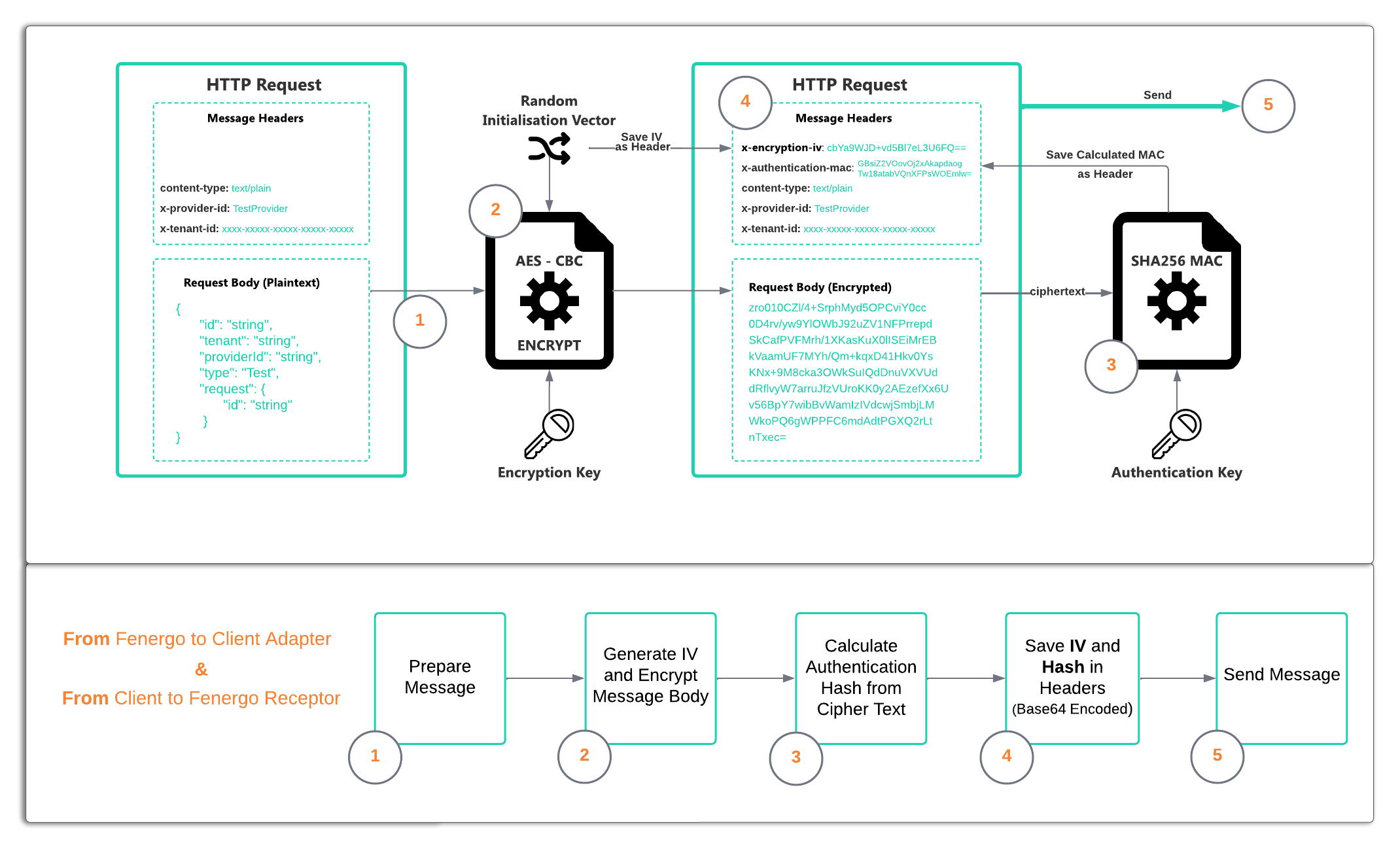
To protect the content of data sent to an External Adapter, The message body content is first encrypted using the AES-CBC Algorithm. This uses both an Encryption Key along with a random Initialization Vector (IV). A separate Authentication Key is used to calculate a hash on the encrypted message body. The random IV and the Hash are sent along with the message as a header. This allows the message to be both decrypted and then validated as coming from a trustworthy source.
Securing a Custom External Adapter
Decrypting a Message
Your adapter implementation (or wherever you relay the messages to if your interface is acting as a proxy) must implement the ability to Decrypt and Authenticate messages received from the Fenergo Saas platform. The process for decryption is illustrated below, all languages support AES and HASH algorithms
C# Code to Decrypt and Authenticate Message
public string dencryptAESBody()
{
    //KEYS are NOT Shown but are referred to as "base64EncryptionKey" and "base64AuthKey"
    //Assume they are defined elsewhere in the code.

    string passedIVinBase64 = "NF/xcZ21LhFIwA31q5oMzw==";
    string passedMAC = "DEL/vVP8qD8feLtJCptnyI4ZYHRMDZ8zjkZk3AZRAnw=";
    string cipherText = "UE30wHm2NrYnKkXBO4TLWdxxxp/QQLY1t1qFyJb3juEIZ+kh00z" +
        "uQ68k8HiPxdlFX9wrrQWgCgjJ/kDhZcnYqTTADXWCzgLH9KCVGf19nz8Yn0XNbzeKiL" +
        "QCvPeIq92UJIIDbon+3eMdOcQ7TOg54jaI6A/2U7A8qWXPbxkEhkd12kKJ4xq4Kg/jf" +
        "lnhDzyKjmhYKzC46CIbk9AecRIvla1oowqqzNKAOdDbu+Vqr9A=";

    using var  aesAlgorithm = Aes.Create();

    aesAlgorithm.Key = Convert.FromBase64String(base64EncryptionKey); //Reading a key from your Keystore
    aesAlgorithm.IV = Convert.FromBase64String(passedIVinBase64);     //passed in from the header x-encryption-iv

    Console.WriteLine($"Aes Cipher Mode : {aesAlgorithm.Mode}");
    Console.WriteLine($"Aes Padding Mode: {aesAlgorithm.Padding}");
    Console.WriteLine($"Aes Key Size : {aesAlgorithm.KeySize}");
    Console.WriteLine($"Aes Block Size : {aesAlgorithm.BlockSize}");

    //Passed in from the Message Body - Convery to byte[] for decryption
    byte[] cipherTextinByteArrayFormat = Convert.FromBase64String(cipherText);
    var encryptor = aesAlgorithm.CreateDecryptor();
    var cipherTextConvertedFromBase64 = Convert.FromBase64String(cipherText);

    using  var memoryStream = new MemoryStream();
    using  var cryptoStream = new CryptoStream(memoryStream, encryptor, CryptoStreamMode.Write);

    cryptoStream.Write(cipherTextConvertedFromBase64, 0, cipherTextConvertedFromBase64.Length);
    cryptoStream.FlushFinalBlock();
    var plaintext  = memoryStream.ToArray();

    //Authenticate the Sender by calculating the HMAC from the ciphertext
    using var hmacSha = new HMACSHA256(Convert.FromBase64String(base64AuthKey)); //Decode Base64 Auth Key
    var calculatedHMAC = hmacSha.ComputeHash(cipherTextinByteArrayFormat);

    Console.WriteLine("Calculated Mac : " + Convert.ToBase64String(calculatedHMAC));
    Console.WriteLine("Recieved   Mac : " + passedMAC); //Passed in from the header x-authentication-mac
    //Decrypted Data made readable with UTF8 Encoding
    Console.WriteLine("Decrypted      : " + Encoding.UTF8.GetString(plaintext));

    //Send back plaintext
    return Encoding.UTF8.GetString(plaintext);
}
The message which was sent was a Test from the Legal Entity Screening Domain. The output from the above code block is as follows:
Aes Padding Mode: PKCS7
Aes Key Size : 256
Aes Block Size : 128
Calculated Mac : DEL/vVP8qD8feLtJCptnyI4ZYHRMDZ8zjkZk3AZRAnw=
Recieved   Mac : DEL/vVP8qD8feLtJCptnyI4ZYHRMDZ8zjkZk3AZRAnw=
Decrypted      : {
                  "Data":
                  {
                    "AdditionalSettings":[]
                  },
                  "Id":"d4b89b85-827c-4d09-bc3e-1cbb39d52a4c",
                  "Tenant":"45bf62ac-e4b1-4c16-ae32-d774cd18db6d",
                  "ProviderId":"TestScreening",
                  "Type":"Test"
                 }
Python Code to Decrypt and Authenticate Message
import base64
from Crypto.Cipher import AES
from Crypto.Hash import HMAC
from Crypto.Util.Padding import unpad
from io import BytesIO

def decrypt_AES_body():
    # KEYS are NOT Shown but are referred to as "base64EncryptionKey" and "base64AuthKey"
    # Assume they are defined elsewhere in the code.

    passed_IV_in_Base64 = "NF/xcZ21LhFIwA31q5oMzw=="
    passed_MAC = "DEL/vVP8qD8feLtJCptnyI4ZYHRMDZ8zjkZk3AZRAnw="
    cipher_text = "UE30wHm2NrYnKkXBO4TLWdxxxp/QQLY1t1qFyJb3juEIZ+kh00z" \
                  "uQ68k8HiPxdlFX9wrrQWgCgjJ/kDhZcnYqTTADXWCzgLH9KCVGf19nz8Yn0XNbzeKiL" \
                  "QCvPeIq92UJIIDbon+3eMdOcQ7TOg54jaI6A/2U7A8qWXPbxkEhkd12kKJ4xq4Kg/jf" \
                  "lnhDzyKjmhYKzC46CIbk9AecRIvla1oowqqzNKAOdDbu+Vqr9A="

    # Reading a key from your Keystore
    encryption_key = base64.b64decode(base64EncryptionKey)
    iv = base64.b64decode(passed_IV_in_Base64)  # passed in from the header x-encryption-iv

    aes_algorithm = AES.new(encryption_key, AES.MODE_CBC, iv)

    printf("AES Cipher Mode: {aes_algorithm.mode}")
    printf("AES Padding Mode: {aes_algorithm.padding.name}")
    printf("AES Key Size: {aes_algorithm.key_size}")
    printf("AES Block Size: {aes_algorithm.block_size}")

    # Convert cipher text from base64 to bytes for decryption
    cipher_text_bytes = base64.b64decode(cipher_text)

    # Decrypt cipher text
    plaintext = aes_algorithm.decrypt(cipher_text_bytes)
    plaintext = unpad(plaintext, AES.block_size)

    # Authenticate the Sender by calculating the HMAC from the ciphertext
    hmac_sha = HMAC.new(base64.b64decode(base64AuthKey))  # Decode Base64 Auth Key
    calculated_hmac = hmac_sha.digest()

    print("Calculated Mac:", base64.b64encode(calculated_hmac).decode())
    print("Received Mac:", passed_MAC)  # Passed in from the header x-authentication-mac
    print("Decrypted:", plaintext.decode())

    # Send back plaintext
    return plaintext.decode()
Encrypting and Signing a Message
C# Code to Encrypt and Sign Message
public async Task encryptAESBody()
{
    //STEP - 1 Prepare The Message
    var plaintext = "{ \"response\":{ }, \"id\":\"d4b89b85-827c-4d09-bc3e-1cbb39d52a4c\", " +
        "\"tenant\":\"xxxxxxx-Your-Tenant-Id-xxxxxx\", \"providerId\":\"TestScreening\", " +
        "\"type\":\"Test\", \"status\":\"Success\", \"errorDetails\":null }";
    byte[] plaintextAsByteArray = Encoding.UTF8.GetBytes(plaintext);

    //STEP - 2 Gnerate IV and Encrypt Message Bodye
    using  var aesAlgorithm = Aes.Create();

    aesAlgorithm.Key = Convert.FromBase64String(base64EncryptionKey); //Reading a key from your Keystore
    aesAlgorithm.GenerateIV();
    aesAlgorithm.Mode = CipherMode.CBC;
    var encryptor = aesAlgorithm.CreateEncryptor();

    using  var memoryStream = new MemoryStream();
    using  var cryptoStream = new CryptoStream(memoryStream, encryptor, CryptoStreamMode.Write);
    cryptoStream.Write(plaintextAsByteArray, 0, plaintextAsByteArray.Length);
    cryptoStream.FlushFinalBlock();
    var cipherText =  memoryStream.ToArray();

    //STEP - 3 Calculate the Authentication Hash
    using  var hmacSha = new HMACSHA256(Convert.FromBase64String(base64AuthKey));
    var calculatedHMAC = hmacSha.ComputeHash(cipherText);

    Console.WriteLine("Base64 IV   : " + Convert.ToBase64String(aesAlgorithm.IV));
    Console.WriteLine("Base64 MAC  : " + Convert.ToBase64String(calculatedHMAC));
    Console.WriteLine("Base64 Body : " + Convert.ToBase64String(cipherText));

    //STEP - 4 & 5 Add the Headers and Send The Message
    //Your Code Implementation to Send Encrypted Message
}
The output from the above code block is as follows:
Base64 IV   : /O0hpcmWjzWrCxpvwAp1fA==
Base64 MAC  : NfXp/n8vpevd+V7uc/ORKSZ7HIqUo2fQwIebCATb7Mg=
Base64 Body : tnktn65X7Niu6ZU7nn8W/O4gFq1fd+EUk9uMzbqMLB7DOfisUMGkXtxuhFd+PYTaTk2+LNss8tn50AC5K1cONVDRJylyAffMGmG2ihRNNYIZk+UU2ch3NLve5ZDqiH6xXJoOaVTfqgPvSuWyu96gDTpohqSTobtc/CItO473ioQnrOkwxKIzjDcP+c8rb5mE8pSTYpI10+NuaEzKUGwEVULRp+wCBvWdxwHfF7786Ad6lqpGfpqvOOut0gelLoEYWvQOQy0tWgsR8Ez49UBxOg==
Python Code to Encrypt and Sign Message
import base64
import hashlib
from Crypto.Cipher import AES
from Crypto.Hash import HMAC
from Crypto.Util.Padding import pad
from io import BytesIO

async def encrypt_AES_body():
    # STEP - 1 Prepare The Message
    plaintext = "{ \"response\":{ }, \"id\":\"d4b89b85-827c-4d09-bc3e-1cbb39d52a4c\", " \
                "\"tenant\":\"xxxxxxx-Your-Tenant-Id-xxxxxx\", \"providerId\":\"TestScreening\", " \
                "\"type\":\"Test\", \"status\":\"Success\", \"errorDetails\":null }"
    plaintext_as_byte_array = plaintext.encode('utf-8')

    # STEP - 2 Generate IV and Encrypt Message Body
    aes_algorithm = AES.new(base64.b64decode(base64EncryptionKey), AES.MODE_CBC)
    iv = aes_algorithm.iv
    encryptor = aes_algorithm.encryptor()

    # Encrypt plaintext
    cipher_text_bytes = encryptor.update(pad(plaintext_as_byte_array, AES.block_size)) + encryptor.finalize()

    # STEP - 3 Calculate the Authentication Hash
    hmac_sha = HMAC.new(base64.b64decode(base64AuthKey), digestmod=hashlib.sha256)
    hmac_sha.update(cipher_text_bytes)
    calculated_hmac = hmac_sha.digest()

    print("Base64 IV   :", base64.b64encode(iv).decode())
    print("Base64 MAC  :", base64.b64encode(calculated_hmac).decode())
    print("Base64 Body :", base64.b64encode(cipher_text_bytes).decode())

    # STEP - 4 & 5 Add the Headers and Send The Message
    # Your Code Implementation to Send Encrypted Message