
Notice of Change: Exclusion of Offboarding and Offboarded Products from Product Risk Assessment

Change Notice Date: August 26th, 2026

Change Target Date: September 29th, 2026

Fenergo is improving how the Product Risk Assessment task treats products that are leaving a client relationship. Products that are being offboarded, that have already been offboarded, or that are marked for deletion will no longer contribute to product risk assessments.

This change addresses long-standing feedback from clients: a product that a customer is in the process of closing, has already closed, or that is pending removal no longer represents live exposure, and continuing to score it can overstate an entity's product risk — and, where product risk feeds entity risk, the entity's overall risk position.

For tenants with the Product domain enabled, the change is available in all non-live tenants from August 26th, 2026, and will be enabled in all live tenants from September 29th, 2026. This communication serves as notice ahead of that rollout.

What Does This Mean for You as a Fenergo User?

Once this change is in effect, a product is excluded from the Product Risk Assessment task if its lifecycle status is any of the following:

  • Offboarding
  • Offboarded

Excluded products are removed before the Product Risk Assessment begins. They are excluded from re-calculation of their individual risk score/rating, and they do not contribute to the aggregate product risk written back to the entity when Save to Entity is enabled.

Because a product's lifecycle status also tells you where it sits in the review cycle, the two exclusions apply to different populations: only a draft product can carry a status of Offboarding, and only a verified product can carry a status of Offboarded.

Excluded products are not displayed within the Product Risk Assessment task. For full transparency, they are recorded on the assessment result under excludedAggregateAssessments (visible when retrieving the assessment via API or using your browser's dev tools), with each entry carrying the product's aggregateId and lifecycleStatus. This allows you to confirm when and why products were excluded from any given assessment. Surfacing excluded products directly within the task view is planned for a future release.

  • What to expect:

    • This change applies only to risk assessments executed on or after the date it is enabled for your tenant. Existing product risk scores and ratings, and the entity risk values already derived from them, are not recalculated, restated or otherwise altered. No historical data is changed, and no backfill or migration is performed. Values change only when the Product Risk Assessment is next triggered for that entity — within a new journey, for example. At that point:
      • If the task is configured to calculate risk for draft products ('Only Assess Products Created/Updated Within Journey' is enabled), the system will only calculate product risk for those with a status of 'Onboarding' or 'In Review', it will exclude any with a status of 'Offboarding' (any previously stored product risk score/rating on that product will remain unchanged).
      • If the task is configured to aggregate Product Risk to the Entity ('Save to Entity' is enabled) the system will exclude the stored risk scores/ratings of products with 'Offboarding' and 'Offboarded' status from that aggregate.
  • Validating ahead of the target date:

    • The change is live in non-live tenants from August 26th, 2026. We encourage you to use the period before September 29th to run your existing journey schemes in a non-live tenant and compare the product risk and entity risk outputs against your current production values, so that any change in risk position is understood and agreed with your risk and compliance stakeholders in advance. If your tenants use any mitigating configuration to adapt for the past inclusion of 'Offboarding' and 'Offboarded' products, you can unwind that configuration as part of your testing. -->
  • No action is required to receive this change:

    • It will apply automatically to all Product domain enabled tenants after 29th September — there is no opt-in, no configuration change, and no journey scheme update needed. We do not anticipate that any client will need to opt out, as the revised behaviour leads to a more accurate reflection of product risk that has been highly requested by our customers.
  • Enabling earlier:

    • If you have completed your review and would like the change applied to your live tenant before September 29th, 2026, please contact your Fenergo Client Partner and we will arrange it.

Why Are We Making This Change?

Product risk exists to describe the risk an institution actually carries through the products a client holds. Until now, the Product Risk Assessment task made no distinction based on where a product sat in its lifecycle — a product a client had asked to close was assessed on exactly the same footing as one they had just opened.

Where an offboarding product carried a high risk rating, it could still affect an entity's aggregate product risk, and therefore its entity risk, even though the institution's exposure to that product was winding down. Reviewers may have needed to override risk ratings to ensure the appropriate level of due diligence was applied.

Excluding offboarding and offboarded products produces a product risk outcome that reflects the client's live relationship. This makes risk outcomes easier to evidence to reviewers, auditors and regulators, and removes a recurring source of unnecessary manual explanation for analysts.

Need Help or Have Questions?

If you have any questions or require support with this transition, please contact your Fenergo Client Partner, who will be happy to assist you.
Notice of Deprecation: Legacy REST Integration Surfaces

Change Target Date: 31st August 2026

Fenergo will be deprecating a set of legacy REST integration surfaces across TM Alerts and Financial Crime Reporting. All deprecated endpoints have direct GraphQL equivalents available via the Supergraph and the FCR Supergraph subgraph.

What Does This Mean for You as a Fenergo User?

Once these changes are in effect, the following REST endpoints and standalone GraphQL APIs will no longer be available:

TM Alerts

  • Standalone TM Alerts GraphQL API (/tmalerts/graphql) — superseded by the Supergraph.
  • Alert assessments — assess transactions, complete assessment.
  • Comments & activity trail — comments and file attachments.
  • File upload — create alert file upload URL.
  • Alert reads — get alert by ID, journey, or entity.
  • Nested reads — transactions, comments, and alerts-by-transaction.

Financial Crime Reporting

  • Standalone FCR GraphQL API — superseded by the FCR Supergraph subgraph.

Why Are We Making This Change?

These legacy REST surfaces have been superseded by GraphQL equivalents that offer greater flexibility, consistency, and performance. Consolidating integrations onto the Supergraph reduces surface area, simplifies maintenance, and ensures all clients benefit from a single, unified API layer.

What Action Do You Need to Take?

If your integration relies on any of the endpoints listed above, you should migrate to the equivalent GraphQL operations via the Supergraph before the change target date. Your Fenergo Client Partner can provide guidance on the available GraphQL alternatives.

Need Help or Have Questions?

If you have any questions or require support with this transition, please contact your Fenergo Client Partner, who will be happy to assist you.

Notice of Deprecation: TM Removal of Alert Metadata Configuration

Change Target Date: May 31st, 2026

Fenergo will be removing the Alert Metadata Configuration section within the Reference Data domain. Due to low usage, this section is no longer required and will be retired at the end of May 2026.

What Does This Mean for You as a Fenergo User?

Once this change is in effect, the Alert Metadata Configuration section will no longer be available within the Reference Data domain.

Why Are We Making This Change?

This section has seen low usage across the platform and is no longer considered necessary. Removing it allows Fenergo to streamline the Reference Data domain and reduce unnecessary complexity for users.

Need Help or Have Questions?

If you have any questions or require support with this transition, please contact your Fenergo Client Partner, who will be happy to assist you.

Notice of Deprecation: TM Removal of Alerted Transactions

Change Target Date: May 31st, 2026

Fenergo will be removing the Alerted Transaction tab in the Alerts Dashboard. An extension of the information available here will be available in Advanced reporting so this tab is no longer useful. Furthermore, removing this information from the Alerts page will enhance the performance of the page. All transaction are available from the Entity profile transaction tab.

What Does This Mean for You as a Fenergo User?

Once this change is in effect, the Alerted Transactions tab will no longer be available in the Alerts dashboard. Alerted transaction information is available in Advanced Reporting.

Why Are We Making This Change?

There are multiple reasons for this change, firstly the need for this tab has been mitigated by adding Alerted Transactions to Advanced Reporting, secondly removing this information will have a positive impact on the performance of the Alert Dashboard.

Need Help or Have Questions?

If you have any questions or require support with this transition, please contact your Fenergo Client Partner, who will be happy to assist you.

Notice of Change: Limiting In-Progress Journeys Per Entity

Change Notice Date: April 27th, 2026

Planned Target Date: June 4th, 2026

Fenergo will be introducing limits on the number of journeys that can be in progress simultaneously for a single entity. This change is designed to protect platform performance and prevent unintended automation from generating excessive workload.

What Does This Mean for You as a Fenergo User?

Once this change is in effect, the following limits will apply per entity:

  • A maximum of 1,000 total in-progress journeys per entity.
  • A maximum of 500 in-progress journeys of the same journey type per entity.

If either limit is reached, the system will reject new journey creation requests with a 400 Bad Request API response. A validation error will be returned within Fenergo indicating whether the total limit or the per-journey-type limit has been exceeded.

If you encounter one of these errors, review and resolve existing in-progress journeys for the affected entity before attempting to create new ones.

Why Are We Making This Change?

This change has been introduced to maintain system stability and mitigate the risk of uncontrolled journey creation caused by configuration or process issues. By capping the number of in-progress journeys per entity, Fenergo can ensure consistent platform performance across all clients and reduce the impact of accidental or automated over-creation of journeys.

Need Help or Have Questions?

If you have any questions or require support with this transition, please contact your Fenergo Client Partner, who will be happy to assist you.

Notice of Change: Rollback Documents as a Data Source in Policy

Change Notice Date: April 2nd, 2026

The recently released Document Metadata Policy Trigger Condition feature has been removed from the platform. Following release, we identified an issue that affects environments with high volumes of documents, and in order to protect the platform stability for all clients we have made the decision to remove this feature at this time while we work on a more robust solution. If you have already begun configuring this feature, please reach out to your Fenergo representitive who will be happy to advise on alternative approaches in the interim. We apologise for any disruption this may cause.

Notice of Change: Significance Task Types New Permission

Change Notice Date: March 19th, 2026

Change Target Date: End of April, 2026

Fenergo will be introducing an update to the permissions required to interact with and complete the Significance Engine Results and KYRA:Signal Results Task Types. This communication serves as notice before the change is rolled out to production environments.

The updated implementation will introduce a new dedicated permission, Significance Task Edit, which will be required to override Significance outcomes and complete the task.

What Does This Mean for You as a Fenergo User?

Once this change is enabled, users will require the Significance Task Edit permission in order to interact with and complete the Significance tasks.

For any tenants already using Significance Task Types, users who currently have Significance Rule Access will continue to be able to view, edit, and complete the task. This is to ensure continuity of access during the transition period.

Why Are We Making This Change?

Following the recent separation of configuration and operational permissions, we identified the need to introduce a dedicated task permission, allowing configurators to better control which users can overwrite outcomes within the task, without granting access to underlying configuration.

This approach mirrors what we already do in other areas of the application and maintains the separation between configurational and operational users while providing greater flexibility and control over task interaction.

Need Help or Have Questions?

If you have any questions or require support with this transition, please contact your Fenergo Client Partner, who will be happy to assist you.

Notice of Deprecation: Entity Profile Page V1

Deprecation Notice Date: February 20th, 2026 Change Target Date: August 31, 2026

Beginning August 31, 2026, the Entity Profile Page V1 will no longer be available. Users will access and manage entity information exclusively through the Entity Profile Page V2 interface. This means the option to switch to or navigate to the Entity Profile Page V1 will be removed and Entity Profile Page V2 will become the only supported experience on this screen across all tenants.

What Does This Mean for You as a Fenergo User?

From August 31st, 2026, users will no longer be able to navigate to the Entity Profile Page V1. All entity-related activities on this screen will be performed exclusively within the Entity Profile Page V2 interface. There are no permission changes associated with this update, and no action is required in advance of the removal date.

Why Are We Making This Change?

Entity Profile Page V2 represents the strategic direction of the platform and provides a more modern and consistent user experience. Retiring the legacy Entity Profile Page V1 removes duplication in the interface and allows ongoing enhancements to be focused on a single, unified experience for the user.

Need Help or Have Questions?

If you have any questions or require support with this transition, please contact your Fenergo Client Partner, who will be happy to assist you.

Notice of Change: Improved user interface of the eSignature task

Change Notice Date: January 12th, 2026

Planned Target Date: End of February, 2026

Fenergo will be making changes to the user interface of the eSignature task. These changes will enhance the user experience of the task.

What Does This Mean for You as a Fenergo User?

Once this change is enabled, users will see the new and improved user interface of the eSignature task. The functionality of the task will remain the same.

eSig Image

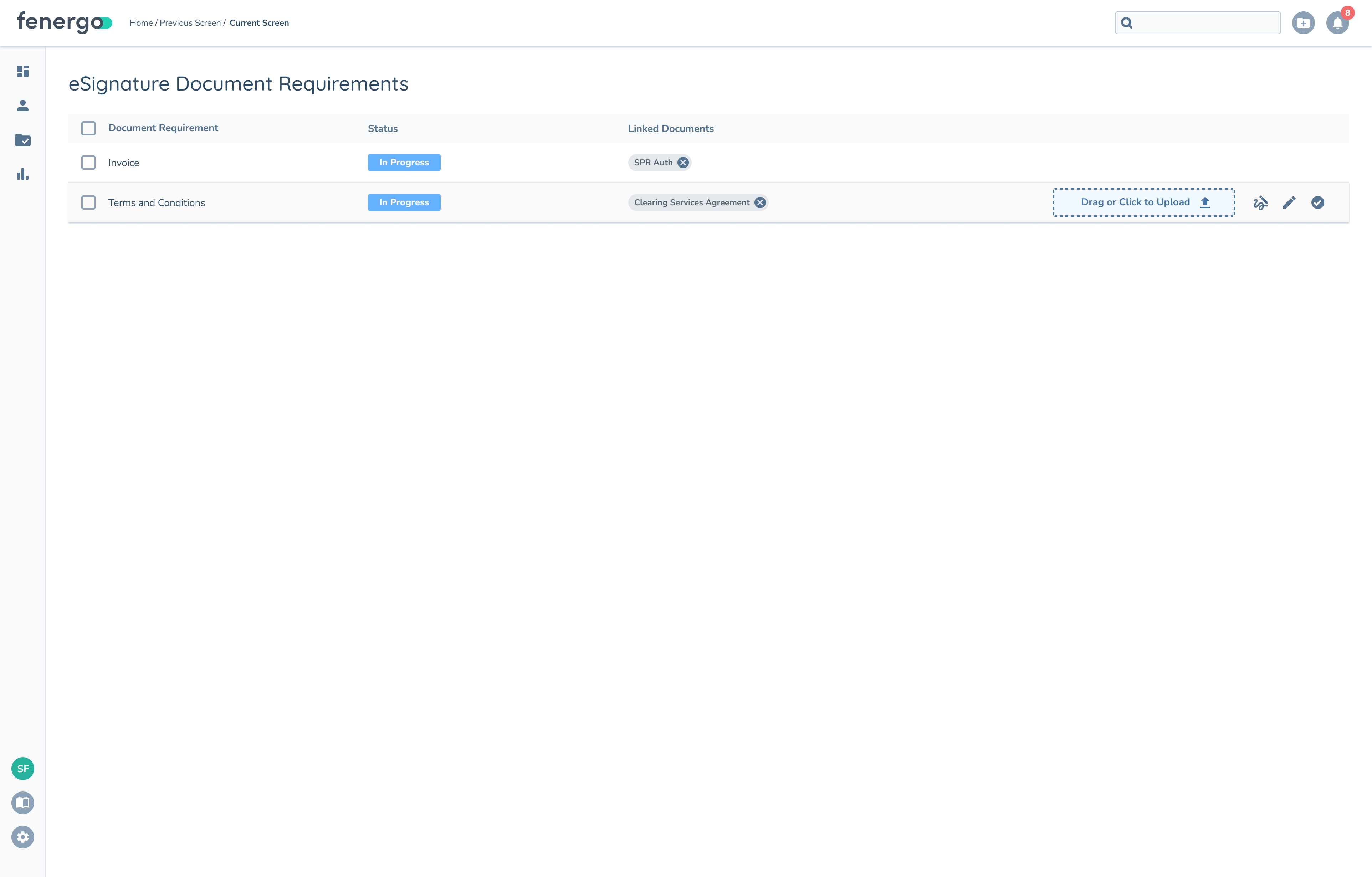
The new and improved UI of the eSig task includes:

  • Adjustment of the margin around the eSignature Document Requirement grid.
  • Wrapping of the 'status chip'.
  • New 'Drag or Click to Upload' component.

eSig Image

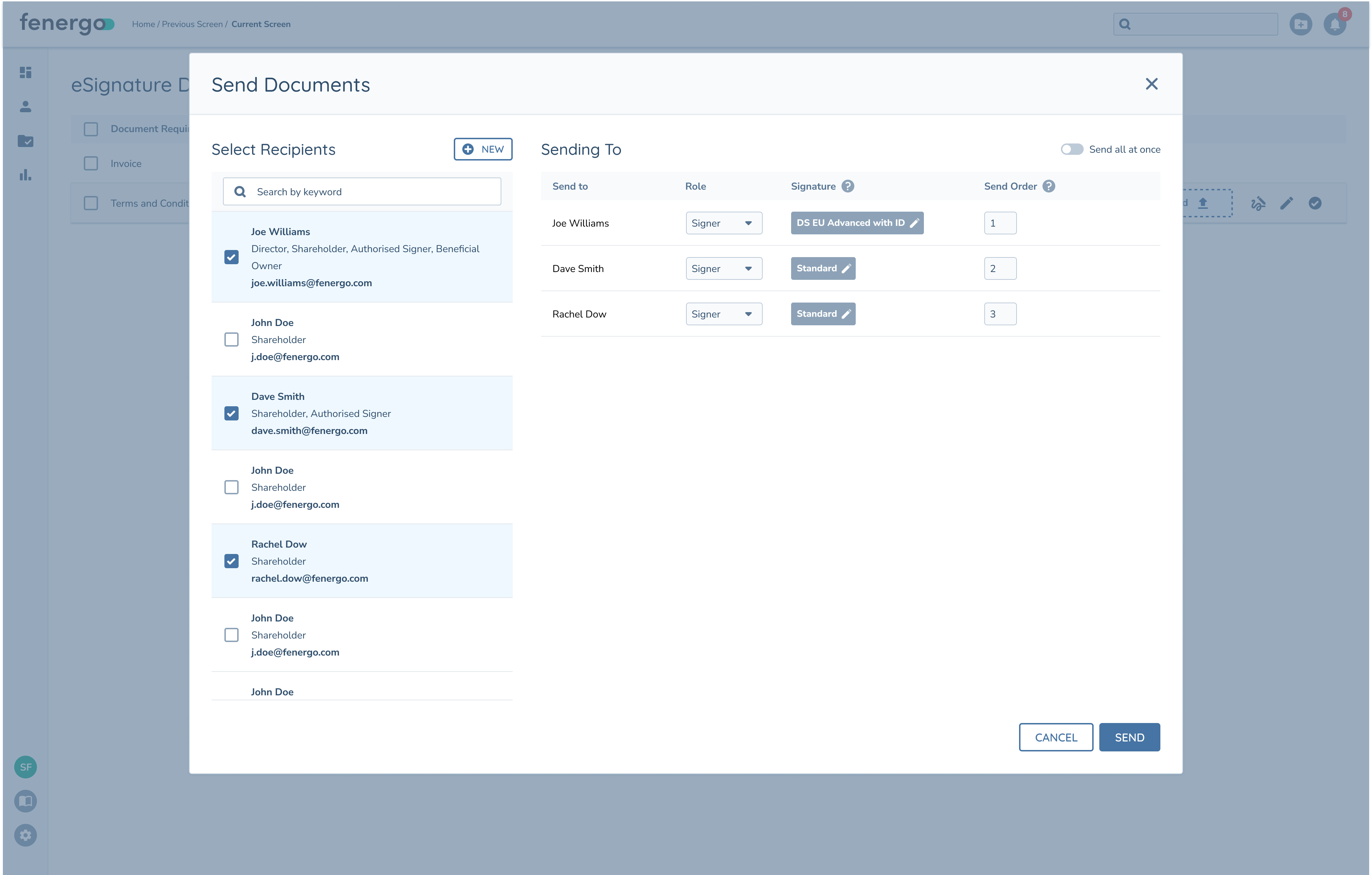
The new and improved UI of the Send Documents modal in the eSig task includes:

  • Highlighting the selected recipients.
  • Adjusments to font, size and style of text.
  • Wrapping of the 'signature type' chip.
  • Recipients will appear in a list rather than a grid.

Why Are We Making This Change?

To ensure a consistent and quality user experience, we are aligning the user interface of the eSignature task with designs created and approved by our user experience team.

Need Help or Have Questions?

If you have any questions or require support with this transition, please contact your Fenergo Client Partner, who will be happy to assist you.

Notice of Change: Significance Task Types Permission Change

Change Notice Date: December 22nd, 2025

Change Target Date: April, 2026

Fenergo will be making a change with regards to the requisite permissions needed to access the Significance Engine Results or KYRA:Signal Results Task Types. This communication serves as notice before the change is rolled out to production environments.

The current implementation ties the access and interactivity of the task with the same permissions required to configure the Significance Rules. This means that the operational users can also see the configuration.

The new implementation will remove any dependency on Significance Rule Access or Significance Rule Edit for task-level access and interactivity.

What Does This Mean for You as a Fenergo User?

Once this change is enabled, users will be no longer require the Configuration Permissions in order to interact with the Significance task.

For any tenants already using Significance Task Types, the existing permission sets will apply until April 2026.

Why Are We Making This Change?

Based on speaking to our clients, we want to be able to provide users with the ability to use the Significance task types without having the ability to view, edit or delete the underlying configuration. This approach mirrors what we already do in other areas of the application. For example, users may interact with policy via a data capture task but may not view the underlying policy configuration. By separating these permissions, we allow for greater separation between configurational and operational users.

Need Help or Have Questions?

If you have any questions or require support with this transition, please contact your Fenergo Client Partner, who will be happy to assist you.